ORIGINAL POSTING: http://money.cnn.com/news/newsfeeds/articles/prnewswire/LA11115.htm
After surviving on a deserted island, she is
now showing the world what it means to fight for better hearing and
reach for the stars
May 19, 2015: 10:08 AM ET
CENTENNIAL, Colo.,
May 19, 2015 /PRNewswire/ --
Cochlear Limited (ASX: COH), the global leader in implantable hearing solutions, announced today a collaboration with
Nina Poersch
from the hit CBS show 'Survivor' to educate the public about what it
means to live with hearing loss and the importance of never giving up on
your dreams. In honor of Better Hearing and Speech Month, Nina is
challenging people with hearing loss to take action, find a solution and
live by her motto 'Go for it, live it and experience it.'
"In
this day and age, we are fortunate enough to have a variety of hearing
loss treatments at our disposal, so there is no reason why anyone should
have to struggle to hear," said
Nina Poersch,
'Survivor' Season 30 contestant and cochlear implant recipient. "Take
my story for instance. When I lost my hearing, I soon realized that
hearing aids wouldn't work for me, but was told that I most likely
wouldn't qualify for a cochlear implant. I insisted on being tested, and
it turned out that I was a candidate for the technology. I have lived
my life the same way ever since. I don't let anything stand in the way
of my dreams just because I may have difficulty hearing."
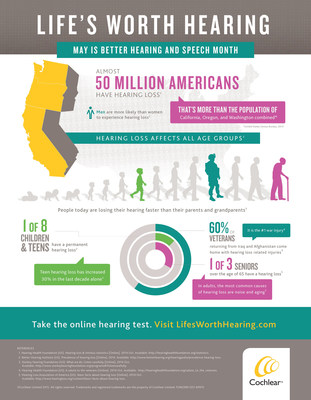
Hearing loss is fast becoming one of the most serious health issues in
the United States:
- It affects almost 50 million Americans – that's more than the population of California, Oregon and Washington combined1,2
- People today are losing their hearing faster than their parents and grandparents3
- 1 of 8 children and teens have a permanent hearing loss3
- 1 of 3 seniors over the age of 65 has a hearing loss4
- 60 percent of veterans returning from Iraq and Afghanistan come home with hearing loss related injuries5
Additionally,
as in Nina's case, many hearing professionals may be unclear of the
current criteria to determine hearing implant candidacy, especially with
newer solutions like Cochlear™ Hybrid™ Hearing. In fact, in a survey of
594 cochlear implant recipients, less than half (46%) reported being
referred by audiologists or hearing aid dispensers, and 20% reported
they were not referred by any professional, and instead learned about
the technology elsewhere.
6 This data demonstrates that it is
increasingly more important for people who are struggling with their
hearing aids to proactively ask their physician about other solutions,
including implantable hearing technology.
"Even the most advanced
hearing aids may not be enough for some people, making it very difficult
to work, advance in their careers and keep in contact with their loved
ones," said
Chris Smith, President of
Cochlear Americas. "This is the reason why we do what we do. We are here
to improve the quality of life of those with hearing loss and empower
them to hear and be heard. We are dedicated to bringing to market new
solutions that treat a variety of different hearing losses and provide
people with a renewed sense of hope where it was once lost. We are
honored to work with
Nina Poersch on this endeavor and encourage those impacted by the condition to take action today."
During
the month of May, Nina will be speaking to local communities around the
country about her cochlear implant story and inspiring them to take
action. To learn more about hearing loss and its treatment options,
visit
www.LifesWorthHearing.com.
About Better Hearing and Speech MonthBetter
Hearing and Speech Month is an annual event that has taken place every
May since 1927. The event was started to raise public awareness,
knowledge and understanding of various forms of communication
impairments, including hearing and speech. With hearing loss becoming
more common as younger people lose hearing due to noise exposure and as
baby boomers age, Better Hearing and Speech Month has become even more
important as a means of reaching those reluctant to have their hearing
tested.
About Cochlear ImplantsCochlear implants are a
proven medical option for infants as young as 12 months old with
profound hearing loss in both ears, children aged two and older with
severe-to-profound hearing loss, and adults with moderate-to-profound
hearing loss in both ears. They are electronic devices that bypass
damaged hair cells in the inner ear, or cochlea, and stimulate the
hearing nerve directly.
According to the National Institute on
Deafness and Other Communication Disorders, approximately 324,200 people
worldwide have received cochlear implants. In
the United States, roughly 58,000 adults and 38,000 children have received them.
7 Nearly two million people in
the United States could be candidates for cochlear implant technology, but only 5 percent of patients who can benefit have been treated.
8,9
About Cochlear Limited (ASX: COH)Cochlear
is the global leader in implantable hearing solutions. The company has a
global workforce of 2,700 people and invests more than AUS$100 million a
year in research and development. Products include hearing systems for
cochlear, bone conduction and acoustic implants.
Over 400,000 people of all ages, across more than 100 countries, now hear because of Cochlear.
www.cochlear.com
References[1] Hearing Health Foundation (US). Hearing loss & tinnitus statistics [Online]. 2014 Oct. Available:
http://hearinghealthfoundation.org/statistics.
[2] United States Census Burearu. 2013
[3] Starkey Hearing Foundation (US). What we do: Listen carefully [Online]. 2014 Oct. Available:
http://www.starkeyhearingfoundation.org/programs#/listencarefully.
[4] Hearing Loss Association of America (US). Basic facts about hearing loss [Online]. 2014 Oct. Available:
http://www.hearingloss.org/content/basic-facts-about-hearing-loss.
[5] Hearing Health Foundation (US). A salute to the veterans [Online]. 2014 Oct. Available:
http://hearinghealthfoundation.org/salute_to_the_veterans.
[6] Cochlear Americas Hearing Aids and Cochlear Implants Recipient Survey,
December 2008.
[7]
National Institute on Deafness and Other Communication Disorders.
Cochlear Implants [Internet] 2014 Aug 18 [cited 2015 Apr 13]. Available:
http://www.nidcd.nih.gov/health/hearing/coch.asp [8] Blanchfield, B.B., et. al. (2001). The severely to profoundly hearing-impaired population in
the United States: Prevalence estimates and demographics. JAAA. 12, 183-189.
[9] Internal Cochlear Data on File. June, 2009.
Photo -
http://photos.prnewswire.com/prnh/20150518/216905-INFO
Logo -
http://photos.prnewswire.com/prnh/20130531/LA23942
SOURCE Cochlear Limited



After years of speech therapy, I still felt totally isolated. Even then I knew that it was not fair that I had to work so hard to learn to speak like a hearing person, only to be isolated by my deafness in social settings.
Sadly, this is a very common experience among hearing impaired people. We often wonder, shouldn’t communication be a two-way street?
I finally got the opportunity in high school to attend a School for the Deaf. Ironically, once I learned American Sign Language, it was then that I felt the least “deaf” and “impaired” than I ever did in the hearing world.
With the communication barriers broken down, I felt like I finally truly belonged somewhere. My personality flourished, and I got to see that while quiet and shy around hearing people, I am vibrant and outgoing around Deaf peers.
Some Deaf people are angry. Only a small percentage of us are born into the Deaf world, the rest have to struggle with our identity and communication barriers throughout our lives.
Growing up, some of us are subjected to years of embarrassing and tedious speech therapy, only to be made fun of for our voices that we worked so hard to acquire.
We master lip-reading, only to be left out of conversations repeatedly. We are given cochlear implants as if it is the cure for all of our woes, yet we still are, and always will be, deaf.
Some of our Deaf peers have been brutally beaten or even killed whenever officers misinterpret our signing as an attempt to resist arrest, or mistake our hard-earned clear voices as a sign that we can actually hear their demands as well.
Some of us have been treated as inconveniences when we pull directly up to the window to order our food or coffee. Some of us have been misdiagnosed with metal health issues we do not have, and in some cases we are given medication for the wrong conditions, locked away in mental health hospitals for years, or denied treatment altogether for conditions we DO have.
This is partially the result of diagnostic tools being designed for patients with spoken language and administered by those who are not well-versed in Deaf culture norms.
Some of us are still denied accommodations or given unqualified interpreters in educational, legal, professional, and medical situations, sometimes with far-reaching or deadly consequences which can change the course of lives and the lives of our loved ones.
We Deaf are less likely to be given leadership roles or denied the jobs we apply for. Yes, some of us are angry.
We are born into a world which we are not completely equipped to fit into, a world designed for those who can hear. Even so, we are amazing.
We are great mothers, fathers, friends, and any other role that can be found in the hearing world. We have a unique perspective on life and a richness of character that comes from our years of struggling with communication barriers and our identity. If only the hearing world could understand this.
The hearing world can do many things to make our world more Deaf-friendly. They can take the time to learn how to accommodate us, and follow through with it. Know that our ability to speak is not always an accurate assessment of how much we can hear.
Police officers and other professional organizations need to make Deaf sensitivity training a part of their core education. Hearing parents of deaf children, help your child find his/her own identity instead of assigning one to them.
At the very least, please do not teach them that those who sign are failures, or that those who choose to learn speech are less Deaf. Take the time to learn about our culture and language. Doing these things is a great start toward making the modern Deaf experience into a more positive one for us.
Jenn Hearn is a Deaf mom of two adorable little boys. She works as an adjunct instructor of ASL and SLI/ASL lab coordinator at University of Cincinnati.
The Limping Chicken is the UK’s deaf blogs and news website, and is the world’s most popular deaf blog.