SPECIAL FROM Grandparents.com
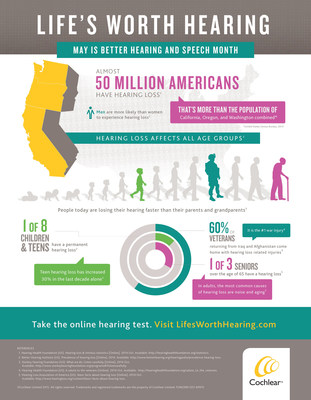
One in seven people between the ages of 45 and 64 have hearing loss — are you taking the proper precautions to protect yourself?
Confronting My Hearing Loss
"I first noticed my hearing loss in my late 50s. Like most people, I ignored it because I thought it didn’t interfere with my life. I also thought acknowledging it would make me old. Over the next 10 years, my hearing worsened and I realized how it was affecting relationships with my family. I thought my grandchildren were mumbling and whispering all the time because I could hardly understand them, especially over the phone.
It took an ear infection to learn how bad my hearing really was. My ENT doctor confirmed my hearing loss and referred me to an audiology practice to be fitted for hearing aids.
I regret waiting so long to do something about my hearing loss. I missed so many conversations and special moments with my husband, children and grandchildren. That’s why I tell people who haven’t addressed their hearing loss, 'What are you waiting for?'"
-- Patty Koele, 71, Ocala, FL
About 14 percent of people between the ages of 45–64 have some type of hearing loss, which you might notice as difficulty following conversations or trouble hearing children and women with high voices. (For a full list of the typical signs and symptoms of early hearing loss, visit Hearingaids.com.) Plus, one in three people over the age of 65 have hearing loss, but, like Patty, they tend to wait a long time before doing something about it—seven years on average.
- Denial and the perception the problem isn’t that serious
- Negative associations of hearing loss and being old or disabled
- Due to gradual onset, those with hearing loss literally don’t know what they are missing
- Not realizing that some hearing loss can be kept from worsening by early treatment
There are three types of hearing loss: conductive (CHL), sensorineural (SNHL), and mixed which includes both types.
CHL hearing loss is a mechanical problem: for some reason, your outer or middle ear isn't able to vibrate properly in response to sound waves. Causes include too much ear wax, fluid due to infection, a hole in the eardrum, and otosclerosis, which is an overgrowth of the bone in your middle ear.
SNHL is the most common type of hearing loss and is caused by noise exposure, medications and age, to name a few. "Though hearing loss is often attributed to natural aging, in fact, hearing loss may be congenital (inherited) or exacerbated by excessive noise," says Leigh Ann Watts, Au.D., CCC-A, an audiologist at Beneficial Hearing Aid Center who treated Koele. "Noise is all around us, every day, from television to lawn mowers to household appliances. It's unavoidable, yet can be harmful in excess."
What Counts as Excessive Noise?
Frightening fact: Hearing loss can occur after a one-time noise exposure at 120 decibels, such as gunfire, or continuous noise exposure to dangerous levels of 85 decibels or above over a prolonged period of time. It's important to know what levels are safe in order to protect your hearing:
110-140 decibels:
Rock concert or jet engine
Firecracker
Nail gun
Ambulance siren
Chainsaw
Home stereo speakers at maximum volume
* Just 1 minute of exposure to noises at this level can result in permanent hearing loss, according to the National Institutes of Health.
85-100 decibels:
Garbage truck
Power mower
Motorcycle
Snowmobile
Jackhammer
* Continual exposure to noises in this range can cause permanent hearing loss.
"I recommend maintaining levels below 75 decibels and listening to your ears," says Dr. Watts. "If a sound is too loud, remove yourself from the situation or put on proper hearing protection." For reference, a normal conversation typically hits about 60 decibels.
What You Can Do If You Do Have Hearing Loss
Fortunately, 90 percent of SNHL hearing loss (caused by excessive noise or aging) can be improved by wearing a hearing aid, and CHL hearing loss (caused by a mechanical problem) can be reversed or significantly improved with medical or surgical treatment, says Dr. Watts.
No matter your specific needs or lifestyle, she recommends the following hearing aid features, if you and your doctor decide to go that route:
Directional microphones – this feature has been proven to improve hearing in places with heavy ambient noise.
Telecoils – this special circuitry within a hearing aid prevents feedback (or whistling) when you're on the phone.
Bluetooth technology – this allows for wireless connection from your hearing aid directly to cell phones and TVs.
Rechargeable hearing aid batteries – they're super convenience and a must for people with visual or dexterity issues.
If you're over 50, hearing aids may conjure visions of clunky, uncomfortable monstrosities—a cure worse than the condition. But today's hearing aids come in comfortable, discreet designs and provide natural-sounding hearing in a wide variety of environments. Another modern benefit: Hearing aids are also available with tinnitus therapy settings for those suffering from ringing in the ear.
Koele decided on the Pure® hearing aid from Siemens. "They're comfortable and don’t plug up my whole ear," she says. "And they do everything I want them to do and connect wirelessly to all my gadgets, so I can listen to music, take calls, and hear the TV right through my hearing aids."
About the author: Jennifer Gehlen received her undergraduate and graduate degrees including her Masters and Au.D. from the University of Florida. She previously worked for Siemens in the roles of staff audiologist providing manufacturing and customer support and as a training consultant. She has practiced audiology in a variety of clinic and hospital settings in northern California and in Florida in the Tampa Bay area over the past 18 years. As an Educational Specialist, she provides training to staff and customers on Siemens technology, services, and software.



After years of speech therapy, I still felt totally isolated. Even then I knew that it was not fair that I had to work so hard to learn to speak like a hearing person, only to be isolated by my deafness in social settings.
Sadly, this is a very common experience among hearing impaired people. We often wonder, shouldn’t communication be a two-way street?
I finally got the opportunity in high school to attend a School for the Deaf. Ironically, once I learned American Sign Language, it was then that I felt the least “deaf” and “impaired” than I ever did in the hearing world.
With the communication barriers broken down, I felt like I finally truly belonged somewhere. My personality flourished, and I got to see that while quiet and shy around hearing people, I am vibrant and outgoing around Deaf peers.
Some Deaf people are angry. Only a small percentage of us are born into the Deaf world, the rest have to struggle with our identity and communication barriers throughout our lives.
Growing up, some of us are subjected to years of embarrassing and tedious speech therapy, only to be made fun of for our voices that we worked so hard to acquire.
We master lip-reading, only to be left out of conversations repeatedly. We are given cochlear implants as if it is the cure for all of our woes, yet we still are, and always will be, deaf.
Some of our Deaf peers have been brutally beaten or even killed whenever officers misinterpret our signing as an attempt to resist arrest, or mistake our hard-earned clear voices as a sign that we can actually hear their demands as well.
Some of us have been treated as inconveniences when we pull directly up to the window to order our food or coffee. Some of us have been misdiagnosed with metal health issues we do not have, and in some cases we are given medication for the wrong conditions, locked away in mental health hospitals for years, or denied treatment altogether for conditions we DO have.
This is partially the result of diagnostic tools being designed for patients with spoken language and administered by those who are not well-versed in Deaf culture norms.
Some of us are still denied accommodations or given unqualified interpreters in educational, legal, professional, and medical situations, sometimes with far-reaching or deadly consequences which can change the course of lives and the lives of our loved ones.
We Deaf are less likely to be given leadership roles or denied the jobs we apply for. Yes, some of us are angry.
We are born into a world which we are not completely equipped to fit into, a world designed for those who can hear. Even so, we are amazing.
We are great mothers, fathers, friends, and any other role that can be found in the hearing world. We have a unique perspective on life and a richness of character that comes from our years of struggling with communication barriers and our identity. If only the hearing world could understand this.
The hearing world can do many things to make our world more Deaf-friendly. They can take the time to learn how to accommodate us, and follow through with it. Know that our ability to speak is not always an accurate assessment of how much we can hear.
Police officers and other professional organizations need to make Deaf sensitivity training a part of their core education. Hearing parents of deaf children, help your child find his/her own identity instead of assigning one to them.
At the very least, please do not teach them that those who sign are failures, or that those who choose to learn speech are less Deaf. Take the time to learn about our culture and language. Doing these things is a great start toward making the modern Deaf experience into a more positive one for us.
Jenn Hearn is a Deaf mom of two adorable little boys. She works as an adjunct instructor of ASL and SLI/ASL lab coordinator at University of Cincinnati.
The Limping Chicken is the UK’s deaf blogs and news website, and is the world’s most popular deaf blog.