Search This Blog

Monday, October 05, 2015

US DOT Officially Requires Closed Captioning on Airport TVs

This is awesome news!


"The ruling, which was in development for nearly 4 years, goes into effect on October 5, 2015. After that date, airport operators will have 30 days to comply." 


US DOT Officially Requires Closed Captioning on Airport TVs

Wednesday, June 03, 2015

ad0d2e13dfece723af719c71ea3771bda5b8c7c47f08ae4352

Friday, May 29, 2015

10 Common Noises That Can Cause Permanent Hearing Loss

http://www.huffingtonpost.com/2013/06/29/hearing-loss-common-noise-that-cause-permanent-damage_n_3503119.html

SPECIAL FROM Grandparents.com
One in seven people between the ages of 45 and 64 have hearing loss — are you taking the proper precautions to protect yourself?
Confronting My Hearing Loss
"I first noticed my hearing loss in my late 50s. Like most people, I ignored it because I thought it didn’t interfere with my life. I also thought acknowledging it would make me old. Over the next 10 years, my hearing worsened and I realized how it was affecting relationships with my family. I thought my grandchildren were mumbling and whispering all the time because I could hardly understand them, especially over the phone.
It took an ear infection to learn how bad my hearing really was. My ENT doctor confirmed my hearing loss and referred me to an audiology practice to be fitted for hearing aids.
I regret waiting so long to do something about my hearing loss. I missed so many conversations and special moments with my husband, children and grandchildren. That’s why I tell people who haven’t addressed their hearing loss, 'What are you waiting for?'"
-- Patty Koele, 71, Ocala, FL
About 14 percent of people between the ages of 45–64 have some type of hearing loss, which you might notice as difficulty following conversations or trouble hearing children and women with high voices. (For a full list of the typical signs and symptoms of early hearing loss, visit Hearingaids.com.) Plus, one in three people over the age of 65 have hearing loss, but, like Patty, they tend to wait a long time before doing something about it—seven years on average.
The reasons for delaying treatment probably sound familiar:
  • Denial and the perception the problem isn’t that serious
  • Negative associations of hearing loss and being old or disabled
  • Due to gradual onset, those with hearing loss literally don’t know what they are missing
  • Not realizing that some hearing loss can be kept from worsening by early treatment
Why Hearing Loss Happens
There are three types of hearing loss: conductive (CHL), sensorineural (SNHL), and mixed which includes both types.
CHL hearing loss is a mechanical problem: for some reason, your outer or middle ear isn't able to vibrate properly in response to sound waves. Causes include too much ear wax, fluid due to infection, a hole in the eardrum, and otosclerosis, which is an overgrowth of the bone in your middle ear.
SNHL is the most common type of hearing loss and is caused by noise exposure, medications and age, to name a few. "Though hearing loss is often attributed to natural aging, in fact, hearing loss may be congenital (inherited) or exacerbated by excessive noise," says Leigh Ann Watts, Au.D., CCC-A, an audiologist at Beneficial Hearing Aid Center who treated Koele. "Noise is all around us, every day, from television to lawn mowers to household appliances. It's unavoidable, yet can be harmful in excess."
What Counts as Excessive Noise?
Frightening fact: Hearing loss can occur after a one-time noise exposure at 120 decibels, such as gunfire, or continuous noise exposure to dangerous levels of 85 decibels or above over a prolonged period of time. It's important to know what levels are safe in order to protect your hearing:
110-140 decibels:
Rock concert or jet engine
Firecracker
Nail gun
Ambulance siren
Chainsaw
Home stereo speakers at maximum volume
* Just 1 minute of exposure to noises at this level can result in permanent hearing loss, according to the National Institutes of Health.
85-100 decibels:
Garbage truck
Power mower
Motorcycle
Snowmobile
Jackhammer
* Continual exposure to noises in this range can cause permanent hearing loss.
"I recommend maintaining levels below 75 decibels and listening to your ears," says Dr. Watts. "If a sound is too loud, remove yourself from the situation or put on proper hearing protection." For reference, a normal conversation typically hits about 60 decibels.
What You Can Do If You Do Have Hearing Loss
Fortunately, 90 percent of SNHL hearing loss (caused by excessive noise or aging) can be improved by wearing a hearing aid, and CHL hearing loss (caused by a mechanical problem) can be reversed or significantly improved with medical or surgical treatment, says Dr. Watts.
No matter your specific needs or lifestyle, she recommends the following hearing aid features, if you and your doctor decide to go that route:
Directional microphones – this feature has been proven to improve hearing in places with heavy ambient noise.
Telecoils – this special circuitry within a hearing aid prevents feedback (or whistling) when you're on the phone.
Bluetooth technology – this allows for wireless connection from your hearing aid directly to cell phones and TVs.
Rechargeable hearing aid batteries – they're super convenience and a must for people with visual or dexterity issues.
If you're over 50, hearing aids may conjure visions of clunky, uncomfortable monstrosities—a cure worse than the condition. But today's hearing aids come in comfortable, discreet designs and provide natural-sounding hearing in a wide variety of environments. Another modern benefit: Hearing aids are also available with tinnitus therapy settings for those suffering from ringing in the ear.
Koele decided on the Pure® hearing aid from Siemens. "They're comfortable and don’t plug up my whole ear," she says. "And they do everything I want them to do and connect wirelessly to all my gadgets, so I can listen to music, take calls, and hear the TV right through my hearing aids."
About the author: Jennifer Gehlen received her undergraduate and graduate degrees including her Masters and Au.D. from the University of Florida. She previously worked for Siemens in the roles of staff audiologist providing manufacturing and customer support and as a training consultant. She has practiced audiology in a variety of clinic and hospital settings in northern California and in Florida in the Tampa Bay area over the past 18 years. As an Educational Specialist, she provides training to staff and customers on Siemens technology, services, and software.


ARE YOU HARD OF HEARING - Free download available for a VISOR CARD for your vehicle

Download Visor Card Here

Visor Cards—Deaf


The purpose of the Visor Card is to bridge the initial communications gap with the police if you are ever stopped by them. It lets the police know you can’t hear/understand their orders and instructions. As a result, they will have to use alternate communication strategies including hand signals, writing things down and use ASL to sign to you.

There are two versions of the Visor Card. The Deaf Visor Card (shown here)  is for people who are culturally deaf—that is, they identify with the Deaf community and use ASL as their primary means of communication, rather than speech.
(The Hard of Hearing Visor Card is for people who identify with the hearing community—that is, they use their voices to speak, read and write English fluently and often speechread and wear hearing aids. To learn more about the Hard of Hearing Visor Card, or to purchase it, click here.)
You can learn more about the reasons for using the Deaf Visor Card and download a free copy of the Deaf Visor Card here, or you can purchase a Deaf Visor Card Pak already made up.
The Deaf Visor Card Pak includes:
  • Laminated “Driver is Deaf” Visor Card
  • Laminated Wallet Deaf Card
  • Brochure: “Visor Cards: Bridging the Communications Gap When Stopped by the Police” including instructions how to use your Deaf Visor Cards. You can also download this full-color 4-page Visor Card Brochure here. 

Correctly Placing Your Visor Cards

Your Visor Cards are useless unless they are instantly available whenever you need them. You don’t want to have to rummage around in the glove box or under the seat when you are pulled over. (Police officers may think you are reaching for a gun and act accordingly.)
The Visor Card is called a visor card for good reason. You attach it to your sun visor. That way, it is normally out of sight, yet instantly available when needed.
Here’s how to mount it. Fold down your sun visor. Place the Visor Card on your sun visor—right side up facing you when your visor is down. Hold it in place with two elastic bands around both the Visor Card and sun visor.
With the sun visor up, your Visor Card is hidden out of sight so you are not advertising the fact that you are deaf, but it is in place, ready for instant use whenever you need it.

Correctly Using Your Visor Cards

If you are ever stopped by the police, follow these steps in this order.
1. Pull over and stop safely. (If it is dark and you are able to, stop under a street lamp, or pull into a lighted parking area. This will make it easier for you to speechread.)
2. Immediately flip your sun visor down, unhook the end by the rearview mirror, and swing it over so your Visor Card is clearly visible in the driver’s side window. If you have two visor cards and you think a police officer will come to the passenger side, deploy that visor too. Even better, deploy both visor cards every time you are stopped. That way, you have your bases covered, no matter what happens.
3. Open your driver’s side window all the way. (Police officers get very nervous with today’s dark windows!) Also open the passenger’s-side window if you flipped that visor down as well.
4. If it is dark, turn on your dome light.
5. Place both of your hands on the steering wheel well before any police officer approaches your vehicle. Police officers want to see both your hands at all times. The safest place is to put them on the wheel at the standard driving positions of 10 o’clock and 2 o’clock. Keep your hands on the wheel until after you establish effective communication with the police officer. Have the officer remove your Visor Card and read the instructions on the back so he knows how to effectively communicate with you.
That’s all there is to it! You may never have to use your visor cards, but if you ever do get pulled over, you are prepared. You can “hang loose” and let your Visor Cards do the work of bridging the initial communications gap with the police.

****you can also order packs of cards from this site.
Shared from -: http://hearinglosshelp.com/shop/visor-cards-hard-of-hearing/


Wednesday, May 27, 2015

'Survivor' Contestant Nina Poersch Shares Her Inspirational Cochlear Implant Story During Better Hearing and Speech Month

ORIGINAL POSTING:  http://money.cnn.com/news/newsfeeds/articles/prnewswire/LA11115.htm

After surviving on a deserted island, she is now showing the world what it means to fight for better hearing and reach for the stars

CENTENNIAL, Colo., May 19, 2015 /PRNewswire/ -- Cochlear Limited (ASX: COH), the global leader in implantable hearing solutions, announced today a collaboration with Nina Poersch from the hit CBS show 'Survivor' to educate the public about what it means to live with hearing loss and the importance of never giving up on your dreams. In honor of Better Hearing and Speech Month, Nina is challenging people with hearing loss to take action, find a solution and live by her motto 'Go for it, live it and experience it.'
May is Better Hearing & Speech Month, so it is time to learn the facts about how addressing hearing loss can help change your life.
"In this day and age, we are fortunate enough to have a variety of hearing loss treatments at our disposal, so there is no reason why anyone should have to struggle to hear," said Nina Poersch, 'Survivor' Season 30 contestant and cochlear implant recipient. "Take my story for instance. When I lost my hearing, I soon realized that hearing aids wouldn't work for me, but was told that I most likely wouldn't qualify for a cochlear implant. I insisted on being tested, and it turned out that I was a candidate for the technology. I have lived my life the same way ever since. I don't let anything stand in the way of my dreams just because I may have difficulty hearing."
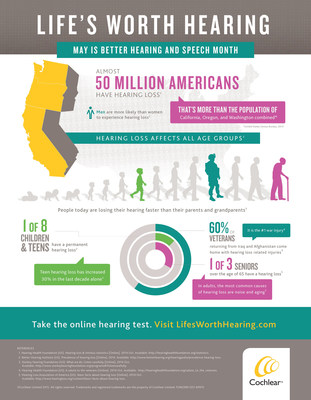
Hearing loss is fast becoming one of the most serious health issues in the United States:
  • It affects almost 50 million Americans – that's more than the population of California, Oregon and Washington combined1,2
  • People today are losing their hearing faster than their parents and grandparents3
  • 1 of 8 children and teens have a permanent hearing loss3
  • 1 of 3 seniors over the age of 65 has a hearing loss4
  • 60 percent of veterans returning from Iraq and Afghanistan come home with hearing loss related injuries5
Additionally, as in Nina's case, many hearing professionals may be unclear of the current criteria to determine hearing implant candidacy, especially with newer solutions like Cochlear™ Hybrid™ Hearing. In fact, in a survey of 594 cochlear implant recipients, less than half (46%) reported being referred by audiologists or hearing aid dispensers, and 20% reported they were not referred by any professional, and instead learned about the technology elsewhere.6 This data demonstrates that it is increasingly more important for people who are struggling with their hearing aids to proactively ask their physician about other solutions, including implantable hearing technology.
"Even the most advanced hearing aids may not be enough for some people, making it very difficult to work, advance in their careers and keep in contact with their loved ones," said Chris Smith, President of Cochlear Americas. "This is the reason why we do what we do. We are here to improve the quality of life of those with hearing loss and empower them to hear and be heard. We are dedicated to bringing to market new solutions that treat a variety of different hearing losses and provide people with a renewed sense of hope where it was once lost. We are honored to work with Nina Poersch on this endeavor and encourage those impacted by the condition to take action today."
During the month of May, Nina will be speaking to local communities around the country about her cochlear implant story and inspiring them to take action. To learn more about hearing loss and its treatment options, visit www.LifesWorthHearing.com.
About Better Hearing and Speech MonthBetter Hearing and Speech Month is an annual event that has taken place every May since 1927. The event was started to raise public awareness, knowledge and understanding of various forms of communication impairments, including hearing and speech. With hearing loss becoming more common as younger people lose hearing due to noise exposure and as baby boomers age, Better Hearing and Speech Month has become even more important as a means of reaching those reluctant to have their hearing tested.
About Cochlear ImplantsCochlear implants are a proven medical option for infants as young as 12 months old with profound hearing loss in both ears, children aged two and older with severe-to-profound hearing loss, and adults with moderate-to-profound hearing loss in both ears. They are electronic devices that bypass damaged hair cells in the inner ear, or cochlea, and stimulate the hearing nerve directly.
According to the National Institute on Deafness and Other Communication Disorders, approximately 324,200 people worldwide have received cochlear implants. In the United States, roughly 58,000 adults and 38,000 children have received them.7 Nearly two million people in the United States could be candidates for cochlear implant technology, but only 5 percent of patients who can benefit have been treated.8,9
About Cochlear Limited (ASX: COH)Cochlear is the global leader in implantable hearing solutions. The company has a global workforce of 2,700 people and invests more than AUS$100 million a year in research and development. Products include hearing systems for cochlear, bone conduction and acoustic implants.
Over 400,000 people of all ages, across more than 100 countries, now hear because of Cochlear.
www.cochlear.com
References[1] Hearing Health Foundation (US). Hearing loss & tinnitus statistics [Online]. 2014 Oct. Available: http://hearinghealthfoundation.org/statistics.
[2] United States Census Burearu. 2013
[3] Starkey Hearing Foundation (US). What we do: Listen carefully [Online]. 2014 Oct. Available: http://www.starkeyhearingfoundation.org/programs#/listencarefully.
[4] Hearing Loss Association of America (US). Basic facts about hearing loss [Online]. 2014 Oct. Available: http://www.hearingloss.org/content/basic-facts-about-hearing-loss.
[5] Hearing Health Foundation (US). A salute to the veterans [Online]. 2014 Oct. Available:  http://hearinghealthfoundation.org/salute_to_the_veterans.
[6] Cochlear Americas Hearing Aids and Cochlear Implants Recipient Survey, December 2008.
[7] National Institute on Deafness and Other Communication Disorders. Cochlear Implants [Internet] 2014 Aug 18 [cited 2015 Apr 13]. Available: http://www.nidcd.nih.gov/health/hearing/coch.asp
[8]  Blanchfield, B.B., et. al. (2001). The severely to profoundly hearing-impaired population in the United States: Prevalence estimates and demographics. JAAA. 12, 183-189.
[9] Internal Cochlear Data on File. June, 2009.
Cochlear Americas logo.
Photo - http://photos.prnewswire.com/prnh/20150518/216905-INFO
Logo - http://photos.prnewswire.com/prnh/20130531/LA23942

SOURCE Cochlear Limited


Friday, April 17, 2015

Jenn Hearn: What I wish the hearing world could understand about deaf people

Posted on April 13, 2015
As a small child at a mainstream hearing school, I remember sitting around the lunch table while my hearing peers told stories. I could not follow what was being said, so I just laughed when they laughed and frowned when they did.
After years of speech therapy, I still felt totally isolated. Even then I knew that it was not fair that I had to work so hard to learn to speak like a hearing person, only to be isolated by my deafness in social settings.
Sadly, this is a very common experience among hearing impaired people. We often wonder, shouldn’t communication be a two-way street?
I finally got the opportunity in high school to attend a School for the Deaf. Ironically, once I learned American Sign Language, it was then that I felt the least “deaf” and “impaired” than I ever did in the hearing world.
With the communication barriers broken down, I felt like I finally truly belonged somewhere. My personality flourished, and I got to see that while quiet and shy around hearing people, I am vibrant and outgoing around Deaf peers.
Some Deaf people are angry. Only a small percentage of us are born into the Deaf world, the rest have to struggle with our identity and communication barriers throughout our lives.
Growing up, some of us are subjected to years of embarrassing and tedious speech therapy, only to be made fun of for our voices that we worked so hard to acquire.
We master lip-reading, only to be left out of conversations repeatedly. We are given cochlear implants as if it is the cure for all of our woes, yet we still are, and always will be, deaf.
Some of our Deaf peers have been brutally beaten or even killed whenever officers misinterpret our signing as an attempt to resist arrest, or mistake our hard-earned clear voices as a sign that we can actually hear their demands as well.
Some of us have been treated as inconveniences when we pull directly up to the window to order our food or coffee. Some of us have been misdiagnosed with metal health issues we do not have, and in some cases we are given medication for the wrong conditions, locked away in mental health hospitals for years, or denied treatment altogether for conditions we DO have.
This is partially the result of diagnostic tools being designed for patients with spoken language and administered by those who are not well-versed in Deaf culture norms.
Some of us are still denied accommodations or given unqualified interpreters in educational, legal, professional, and medical situations, sometimes with far-reaching or deadly consequences which can change the course of lives and the lives of our loved ones.
We Deaf are less likely to be given leadership roles or denied the jobs we apply for. Yes, some of us are angry.
We are born into a world which we are not completely equipped to fit into, a world designed for those who can hear. Even so, we are amazing.
Jenn Hearn
Jenn Hearn
We have our own unique collectivist culture and Signed Languages. We have fellow Deaf peers in the White House, or working as dentist, authors, physicians, lawyers, engineers, and professors.
We are great mothers, fathers, friends, and any other role that can be found in the hearing world. We have a unique perspective on life and a richness of character that comes from our years of struggling with communication barriers and our identity. If only the hearing world could understand this.
The hearing world can do many things to make our world more Deaf-friendly. They can take the time to learn how to accommodate us, and follow through with it. Know that our ability to speak is not always an accurate assessment of how much we can hear.
Police officers and other professional organizations need to make Deaf sensitivity training a part of their core education. Hearing parents of deaf children, help your child find his/her own identity instead of assigning one to them.
At the very least, please do not teach them that those who sign are failures, or that those who choose to learn speech are less Deaf. Take the time to learn about our culture and language. Doing these things is a great start toward making the modern Deaf experience into a more positive one for us.
Jenn Hearn is a Deaf mom of two adorable little boys. She works as an adjunct instructor of ASL and SLI/ASL lab coordinator at University of Cincinnati.
The Limping Chicken is the UK’s deaf blogs and news website, and is the world’s most popular deaf blog.

Jenn Hearn: What I wish the hearing world could understand about deaf people

The Limping Chicken is the UK’s deaf blogs and news website, and is the world’s most popular deaf blog. 
Make sure you never miss a post by finding out how to follow us, and don’t forget to check out what our supporters provide: 

Monday, October 21, 2013

5 amazing facts about the cochlea


What a great article - Thank you Melissa Waller


5 amazing facts about the cochlea

5 amazing facts about the cochlea
Every day I get reminded of just how amazing the cochlea is (the picture at the top of this post is from inside the cochlea!). Today I wanted to share with you some of my favorite quick facts.

1. The Cochlea Turns “Sound” into “Hearing”

Sound waves are almost everywhere. But even though your brain is a really amazing organ, it alone isn’t able to recognize sound waves. That’s the job of the cochlea! The cochlea is the innermost part of the ear and connects directly to the brain.
When the ear picks up sound vibrations they’re sent through different parts of the ear and into the cochlea, in the same way that a funnel directs liquid. In the cochlea these sound vibrations are turned into little electrical signals that go straight to the brain. Then, the brain’s nerve cells take over and you perceive the sense that we call “hearing.” And all of this happens almost instantaneously.

2. It’s The Size of a Pea

Each cochlea is incredibly tiny. It’s about the size of a pea and from the outside looks like a tiny little snail shell. But inside of this tiny little organ are all sorts of little structures that work together to turn sound into hearing. They’re all rolled up into a spiral, but if you would unroll an average cochlea it would end up being a tube about 31.5mm long. This tube can be a few millimeters wide at the base, but towards the very top it shrinks to mere fractions of a millimeter. Within this small distance is everything that your body needs to turn sound vibrations into hearing.

3. There Are Over 20,000 Nerve Cells in the Average Cochlea

Just because it’s tiny doesn’t keep it from being filled with all sorts of special cells. In fact, there are over 20,000 hair cells that are entirely responsible for receiving sound waves and turning them into hearing.
Check out the photo at the top of this post to see what they look like: the green parts are just a few of these 20,000 cells. And to give you a sense of scale, each of the green cells is less than 20 micrometers long (0.0007 inches)! The little hairs on the very top vibrate back and forth in response to sound waves, and then these vibrations are turned into electrical signals within the bigger green parts. The yellow parts are part of the auditory nerve, and are like the roads that send these electrical signals straight to the brain.

4. Different Nerve Cells Cause Different Sounds to be Heard

All 20,000 of these cells are spread along the distance of the cochlea, or about 31.5mm. But if you stimulate two different hair cells that are far apart, you would hear two completely different sounds. This happens because of the way that the hair cells are arranged along a membrane within the cochlea. The membrane is short and stiff on one end so it only responds to high-pitched sounds (like a bird’s chirp), while the other end is longer and more flexible so it only responds to low-pitched sounds (like the beat of a drum). This is called “tonotopy,” and it’s so cool that it deserves a story all on its own – more about that another time!

5. Fluid Inside the Cochlea Makes Waves

The membrane vibrates, but it doesn’t vibrate in air. Instead, the part of the cochlea that touches these hair cells and the membrane is filled with a special fluid called endolymph. Because this fluid is heavier than air, it moves with more force so that the hair cells and membrane can work more efficiently. It’s a lot like the difference between having a summer breeze in your face and being hit by a strong wave along the beach.
(Photo of the Organ of Corti courtesy of R. Glueckert , K. Pfaller, A. Schrott-Fischer, H. Rask-Andersen; Medical University of Innsbruck, Austria)
Have you got a question about the cochlea or do you know something about the cochlea that we haven’t covered?


Author Bio

Melissa Waller

Melissa Waller is an audiologist with a special interest in electrical stimulation of the apical region of the cochlea. She has a Masters of Science in Audiology from the University of Texas at Dallas and a Bachelors of Science in Education of the Hearing Impaired from Southern Methodist University in Dallas, Texas.

Friday, September 13, 2013

Informational: Hearing Loss Association of Pittsburgh

HLA-PA Logo

Hearing Loss Association of Pittsburgh

Meetings are held the third Saturday of the month at 10:00 am except June (picnic), July, August, and December (holiday party)
Meeting location:
DePaul School for Hearing and Speech
6202 Alder Street
Pittsburgh, PA
CONTACT:
Teresa Nellans, President
Email Teresa Nellans

Newsletter:
To subscribe to our newsletter, send email to HLAP.News@gmail.com
Read our latest Newsletter in pdf format HERE.

http://www.hla-pa.org/  - Right hand side, select Pittsburgh

Monday, September 09, 2013

HOW TO UNDERSTAND & RELATE WITH DEAF / HARD OF HEARING (hoh) PEOPLE

I took the liberty of taking this document and adding /hoh after deaf so it includes both deaf and hard of hearing.  I am currently experiencing challenges in my work environment - I'm certain this is not the norm.  I'm staying proactive and keep moving forward, but it's not a good place for anyone to be in.  If I can help someone understand the challenges by posting this... I've done my part.

Communication is a two way street!


HOW TO UNDERSTAND &
RELATE WITH DEAF / HARD OF HEARING (hoh) PEOPLE
 DO:

*Learn the manual alphabet and sign language. Even a little helps!
*Make sure you have the attention of the deaf/hoh person before communicating.
*When communicating, focus your attention on the deaf/hoh person. If a hearing person comes and interrupts, first excuse yourself a moment, before turning away from the deaf/hoh person.
*Use facial expression and natural mouth movement. 
*If communicating with someone who can lip read, speak slowly and clearly with a normal tone of voice.
*If possible, include the deaf/hoh person in the conversation when a hearing person joins. No one likes to be left out.
*Help the deaf/hoh person to feel comfortable during social gatherings. Introduce them to your hearing friends.

 DO NOT:

*Don't refer to the deaf/hoh as "deaf & dumb", or as "deaf-mute's"
*Don't insist that the deaf/hoh person try and talk.
*Don't place your hands in front of your face or lips when communicating with the deaf/hoh. Your face and lips give the deaf many clues to meanings they must see!
*Don't turn away from the deaf/hoh person when communicating.
*Don't talk down to a deaf/hoh adult. Don't be paternalistic and assume you know what deaf/hoh people need or want.
*Don't stare at the deaf/hoh person -- it is rude in any culture!.
*Don't persist in helping the deaf/hoh IF it is not needed. Help, Yes! Embarrass, NO!
*Try and find out the interests and opinions of the deaf/hoh and allow them to express themselves freely.
*Don't become discouraged if you have difficulty learning sign language well. Don't be afraid to ask the deaf/hoh person to sign slowly, just as you must talk slowly when speaking.
*Don't complain if a deaf/hoh person needs your assistance with a phone call.
*Don't forget about deaf/hoh people at meetings. They can "take an active part"!

 REMEMBER:

*Some deaf/hoh have their doctorate degree, and some have excellent reading ability. But remember that not hearing the sounds, has made it very difficult for the average deaf person to learn vocabulary and grammar. The average reading level of the average deaf is about grade 5 (more or less). Keep this in mind and learn the approximate reading level of the deaf person, and work with that level.

*Deaf/hoh people are often discriminated against in the work place. Not only is the unemployment rate higher, but often being passed by for promotions, often leaves deaf/hoh under paid, and under-employed (and sometimes also frustrated!)

*The "Deaf World" has its own culture with what is accepted and not accepted! On the one hand you often find more hugging, on the other, the deaf world does not "pussy foot around" like the hearing, but may be much more blunt and frank about expressing opinions, likes and dislikes!

*Deaf/hoh have often been left out, mistreated, controlled and manipulated by the hearing world. Underneath there may be a high level of distrust, until you have proved your love, responsibility and reliability, and that you are not there to control and manipulate them but to accept them as equal individuals to you.

*Deaf "Signs" will vary from place to place just like a Newfoundland or New York or Southern "accent". Signs will vary somewhat around North America.

*Deaf may be unaware of things you think are common knowledge. Remember, they often have missed hearing many of the little do's and don'ts as a child from around home, as well as much of the background information you picked up by over-hearing conversations as a child.

Courtesy to:  http://www.deafhope.org/do&dont.htm

Thursday, April 11, 2013

MED-EL Launches World’s First Single-Unit Processor for Cochlear Implants

SOURCE: http://www.businesswire.com/news/home/20130410005251/en/MED-EL-Launches-World%E2%80%99s-Single-Unit-Processor-Cochlear-Implants

MED-EL Launches World’s First Single-Unit Processor for Cochlear Implants

RONDOTM processor combines control unit, battery pack, and coil into a compact, single-unit design
DURHAM, N.C.--()--Hearing implant leader, MED-EL Corporation USA, today announced the launch of the world’s first single-unit processor for cochlear implants, the RONDO™. For the first time, the control-unit, battery pack and coil are combined into one single unit. The announcement was made at the Combined Otolaryngology Spring Meetings (COSM) in Orlando, Fla.
“RONDO is one of the most innovative and highly-anticipated cochlear implant developments that has been brought to market by MED-EL”
“RONDO is one of the most innovative and highly-anticipated cochlear implant developments that has been brought to market by MED-EL,” said Richard Collette, President and CEO, MED-EL Corporation USA. “This launch continues MED-EL’s tradition of developing revolutionary solutions designed to fit the unique hearing loss situation and lifestyle of our recipients.”
The fully-integrated design makes RONDO simple to wear, and is especially comfortable for people who wear glasses of any kind. With no cable and fewer parts, users benefit from enhanced durability.
RONDO is based on the proven OPUS Audio Processor platform and features the same signature MAESTRO System Software technologies. This includes Automatic Sound Management, which ensures optimal hearing in changing and challenging listening situations, all without requiring the user to make program adjustments. The processor also features FineHearing®1 Technology, which provides an even more detailed hearing experience. The new processor comes with MED-EL’s exclusive FineTuner remote control, used to adjust program, volume, sensitivity and a variety of other listening parameters.
Staying true to the company’s commitment to forward compatibility, RONDO can be used with MED-EL CONCERT, SONATA, PULSAR and C40+ implants, and has been designed for compatibility with future sound coding strategies.
RONDO is available in four colors: Anthracite, Nordic Grey, Creme and Ebony. The processor is covered by MED-EL USA’s industry-leading standard 5-year warranty for all major external parts, with no special enrollment necessary. Current MED-EL users have the option of exchanging an OPUS 1 or OPUS 2 Audio Processor for a RONDO.
For a limited time, new RONDO recipients – either new patients or current patients who exchange their existing MED-EL processor for a RONDO – will receive a complimentary Bluetooth-compatible neckloop. This special promotion is only available in the USA. For details about the RONDO and exchange program, hearing loss professionals, candidates and existing users can contact MED-EL toll free at (888) MED-EL-CI (633-3524), or at implants-USA@medel.com.
About MED-EL
MED-EL Medical Electronics is a leading provider of hearing implant systems worldwide. The company was founded by Austrian scientists and industry pioneers Ingeborg and Erwin Hochmair, who together developed the world’s first microelectronic, multichannel cochlear implant in 1977. In 1990, they laid the foundation for the successful growth of the company when they hired their first employees. To date, the privately held company now has over 1400 employees around the world.
The cochlear implant was and remains the first replacement of a human sense, the sense of hearing. Today, MED-EL offers the widest range of implantable solutions worldwide to treat the various degrees of hearing loss, including cochlear, middle ear and bone conduction implant systems as well as a system for combined electric and acoustic stimulation.
MED-EL’s mission is to overcome hearing loss as a barrier to communication and quality of life. Individuals in more than 100 countries enjoy the gift of hearing with a MED-EL Hearing Implant System. www.medel.com
1 FSP is not indicated for use by prelingual children in the USA. 23872r1.0

Contacts

RNT Communications
Rebecca Novak Tibbitt, 704-341-1544
rebecca@rntcommunications.com

Day 181

It is very hard to explain just how this journey has impacted my life... the sounds that have opened up since my initial processor turn on.  

I'm so accustomed to my processor now, I can't bear to be without it! 

Birds are a big thing in my daily life!  

A new sounds the past couple months:
Bicycle brake squeaks
Emergen-C fizzing when it hits the water
Clicks of my keys on my name badge
Hospital machine beeps
Gas pump beeps
Camera click on the iPhone
My daughter's bird imitations

I still do not have taste on the one side of my tongue and my ear, as I understand will always feel stuffy.